
In Zanzibar, schooling has long emphasized academic theory over the practical competencies young people need to thrive. Although life skills are recognized in policy frameworks, the translation into classroom
practice has been limited, inconsistent, and often disconnected from learners’ realities. For many adolescents, especially those from lowincome households, the absence of these skills
narrows their prospects for employment, confidence, and long-term self-reliance. ALiVE assessment (RELI, 2022) indicated that, in Zanzibar only 14 percent of adolescents demonstrated proficiency in problem solving.
Moreover, it was evident, during parental engagement in Zanzibar, many girls appeared shy
and hesitant at first, yet became expressive and confident when supported through
interactive engagement. These insights strengthened the urgency to redefine learning
success beyond literacy and numeracy. They highlighted the need for children to develop
social and emotional competencies essential for navigating the demands of the 21st century.
ALiVE initiative aims to make this shift systemic by integrating life skills into curriculum,
assessment, teacher capacity building, and school culture.
The Challenge
According to baseline assessment, parents and teachers across Zanzibar struggled to ground
life skills in practical and relatable activities. Communication, creativity, and problem-solving
remaine abstract concepts that were difficult to translate into everyday teaching. For
adolescents facing poverty, these skills were not simply academic outcomes, they were tools
for navigating daily life and building future opportunities. Gender norms created additional
barriers by limiting girls’ opportunities to explore creative or entrepreneurial activities
outside household responsibilities.
“We were meeting children with extraordinary imagination and talent,” reflects Madam
Sazia, Manager at SAZANI Trust.
“But their potential is locked behind a system that does not give them room to try, fail, experiment, or even dream. We knew that if we could connect classroom learning with real-life experiences, these young people would not only build confidence but would begin shaping their own futures.”
The Solution: Life Skills Clubs as Engines of Creativity
Through Parental Engagement Campaign through UWEZO Tanzania coordination
SAZANI Trust and Milele Zanzibar Foundation (MZF) partnered with more than 10
schools across Urban District, Unguja to establish Life Skills Clubs. These were safe,
creative, and hands-on spaces where learners practiced life skills every day. For one
hour daily, students explored communication, teamwork, creativity, and problemsolving through practical activities that allowed them to engage fully and confidently.
With tools, training, and mentorship from SAZANI Trust and Milele Zanzibar
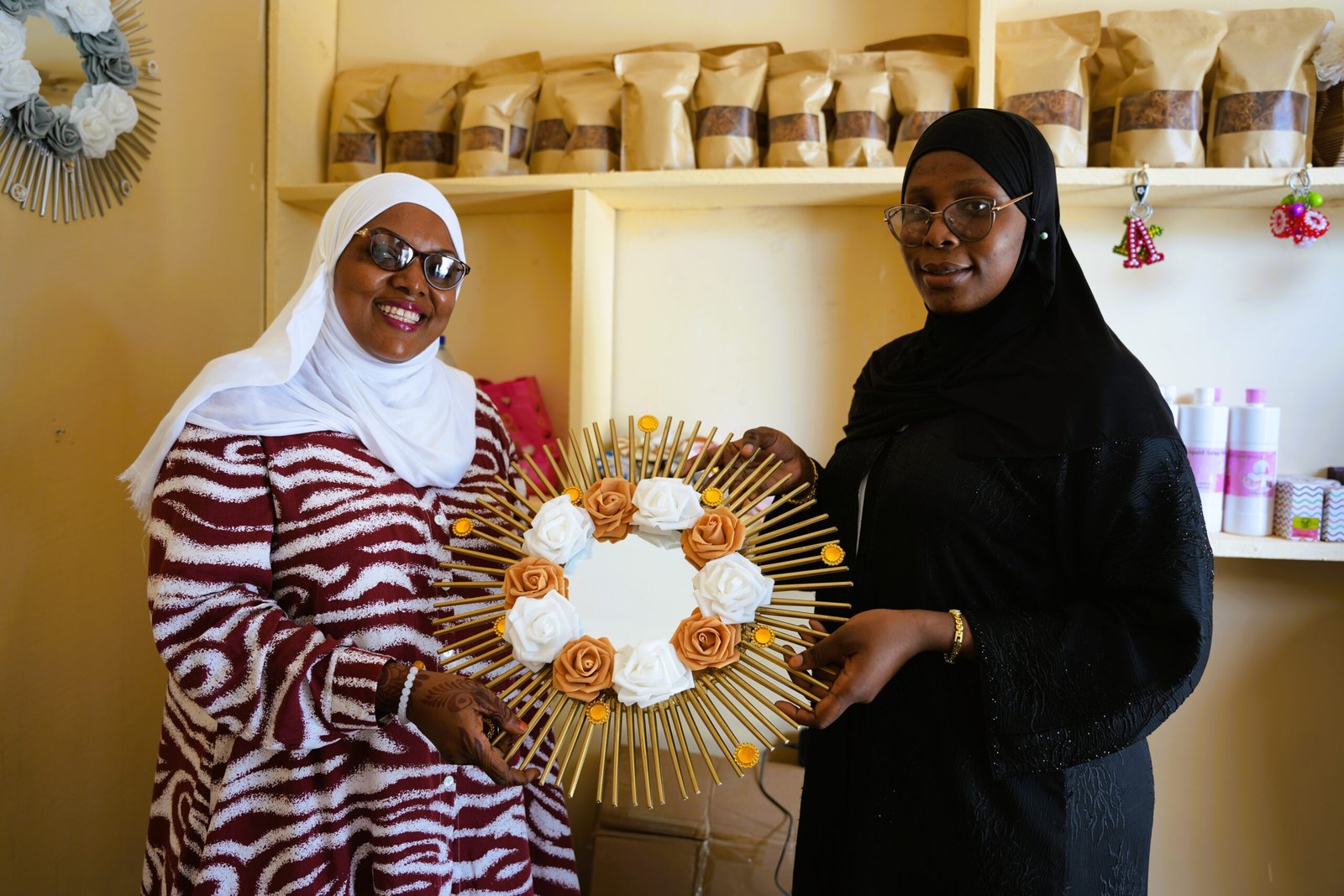
Foundation, students began developing skills in handcrafting, natural product making,
and basic entrepreneurship. They later formed an association called Diya Decorations
Zanzibar. The group produced dcor items such as mirrors, vases, and floral
arrangements, along with natural products including soaps, coconut oil, and perfumes.
What started as a classroom activity quickly evolved into a pathway for selfexpression and income generation.
“The clubs became more than after-school sessions,” says Madam Sazia.
“They became incubators of identity and self-belief. When a learner
holds a finished product in their hands, something they designed, shaped, and perfected,
you can see the shift in their confidence. They stand taller. They begin asking bigger
questions about their future. That is the power that support from partners and donors
unlocks. It is the journey from hesitation to self-reliance.”
Breaking Cultural Barriers
Introducing creative and income-generating activities, especially for girls,
required meaningful community dialogue and trust-building.
“At first, many parents wondered why their daughters should spend time crafting
or creating instead of doing house chores,
” Sazia recalls.
“But once they saw the quality of the products, the teamwork, and the confidence the children were gaining, everything changed. Parents began to celebrate their daughters’
creativity. Some even started placing small orders. That shift in mindset is a
victory because when the community believes in girls, girls believe in themselves.”
A parent from Unguja echoes this shift in perspective:
“When my daughter first joined the club, I was not convinced it was useful,
” says Fatma, a mother of three.
“But then she started bringing home things she had
made with her own hands. I saw her excitement and how she spoke with
confidence. I realized she was learning skills I never had the chance to learn.
Today, I support her completely because I can see she is building a future that
belongs to her.”
Building on the demonstrated success of the ten-week parental engagement
campaign, the next phase of ALiVE will focus on institutionalizing parental
engagement as a permanent pillar of the education system, to spear head mindset and
cultural shifts – rather than a time-bound project activity. This means embedding
parental engagement approaches within national and sub-national education policies,
PTA and school governance guidelines, teacher professional development frameworks,
and community education strategies. Parents will increasingly be recognized and
supported as co-educators, with clear roles in nurturing life skills and values
alongside schools.
Programmatically, ALiVE will work to scale the campaign model by identifiy and
working with more champions using using a standardized but adaptable packages and
monitoring systems: facilitator guides, community dialogue tools, games-based home
activities, and digital monitoring tools. Emphasis will be placed on building districtlevel and school-level facilitation capacity, enabling local education offices, Parents
Teachers Associations (PTAs), and civil society partners to independently lead
implementation. Digital and print repositories of parental engagement resources will
further expand reach at low cost.
Content-wise, future campaigns will broaden from an initial focus on problem-solving
to a progressive suite of life skills and values including communication, collaboration,
self-awareness, empathy, decision-making, and responsible citizenship sequenced
across age groups. Stronger links will be forged between what children practice at
home and what teachers nurture in classrooms, reinforcing coherence across learning
environments.
Finally, ALiVE will strengthen evidence generation and learning loops, integrating
simple monitoring tools into school and PTA routines, conducting periodic light-touch
assessments, and documenting community-level innovations. This will ensure
continuous improvement, policy-relevant learning, and sustained advocacy. Looking
ahead, parental engagement will move from a promising intervention to a systemic
engine for holistic learning, shaping how Tanzania defines, Delivers, and measures
educational success.